Article: How to choose the right hunting knife
How to choose the right hunting knife
A good knife is one of those pieces of equipment that quickly becomes a permanent part of your hunting kit. Whether you need it for handling game, preparing food, cutting rope or taking care of small jobs around camp, the right knife can serve you for years.
But choosing one is not always straightforward. Fixed blade or folding knife? Plain or serrated edge? What type of grind should you look for? There is no single knife that is perfect for every hunter or every situation, so the best place to start is by considering what you will actually use it for.
What should you look for in a hunting knife?
Before choosing a knife, think about the tasks it needs to handle. A knife primarily used during hunting may have different requirements from one intended for general outdoor use, camp work or wood carving.
Price, availability and local laws concerning knives and blade length may also influence your choice. If you need one knife for many different tasks, some compromise is inevitable. A good-quality general-purpose knife will handle most everyday hunting and outdoor jobs without difficulty, while more specialised tasks may call for a second knife designed specifically for that purpose.
Personal preference matters too. Ask several experienced hunters which knife they prefer and you are likely to get several different answers. What matters most is finding a knife that feels comfortable and secure in your hand and suits the way you hunt.
Plain, Serrated or Combination Blade?
One of the first choices is the type of cutting edge.
A plain-edge blade is the most versatile option for many hunters. It produces clean, controlled cuts and is relatively easy to sharpen, including in the field. For preparing food, carving wood, making tent pegs and many everyday camp tasks, a sharp plain edge is difficult to beat. Its main limitation is when cutting tough, fibrous materials such as heavy rope, where it may lose its edge faster than a serrated blade.
A serrated blade works more like a small saw. The teeth grip tough or fibrous materials and can continue cutting effectively even when the edge is no longer perfectly sharp. The trade-off is precision: serrated blades tend to produce rougher cuts and are considerably more difficult to sharpen properly.
A partially serrated or combination blade offers some of both. Part of the blade has a plain edge for controlled cutting, while another section is serrated for tougher materials. It can be a useful compromise when you want one knife to perform a wide range of tasks, although the shorter usable length of each type of edge can sometimes be limiting.
For most general hunting and outdoor use, a quality plain-edge knife is an excellent starting point. If cutting rope and other tough materials is a regular part of what you do, a combination blade may be worth considering.

Understanding Knife Grinds
The grind describes how the blade narrows towards its cutting edge. It affects how sharp the knife can become, how durable the edge is and how easy it is to maintain.
A hollow grind can produce an extremely sharp, fine edge, but because there is less material behind it, the edge can also be more vulnerable to damage during heavy use.
A flat grind is common on many general-purpose knives. It offers a useful balance between cutting ability and strength and is also familiar from many kitchen knives.
A convex grind has more material behind the cutting edge, making it strong and well suited to demanding work. It can cut very smoothly while remaining durable, although producing and sharpening a good convex edge requires more skill.
The Scandi grind is particularly common on Scandinavian outdoor and bushcraft knives. Its strong, simple geometry works extremely well for woodworking and general outdoor tasks. The broad bevel is relatively easy to understand when sharpening, although repairing a badly damaged edge can require considerable work.
There is no universally superior grind. A hunter who mainly needs precise cutting performance may prioritise something different from someone who regularly uses a knife for demanding camp and bushcraft work.

A knife should feel right in your hand
Blade specifications are important, but so is the handle. A knife may look ideal on paper and still feel wrong once you start working with it.
You should be able to hold the knife securely without having to squeeze the handle excessively. Consider how it feels when your hands are wet or cold and whether the shape allows you to control the blade during both delicate and more demanding cuts.
This is especially relevant when choosing hunting equipment and having smaller hands. A large handle is not automatically better or safer. Hand size varies enormously between individuals, so choose a knife based on your own grip and control, rather than assuming that a particular size is suitable simply because it is marketed as standard.
Good control is far more important than carrying the biggest knife possible.
Carrying your knife safely
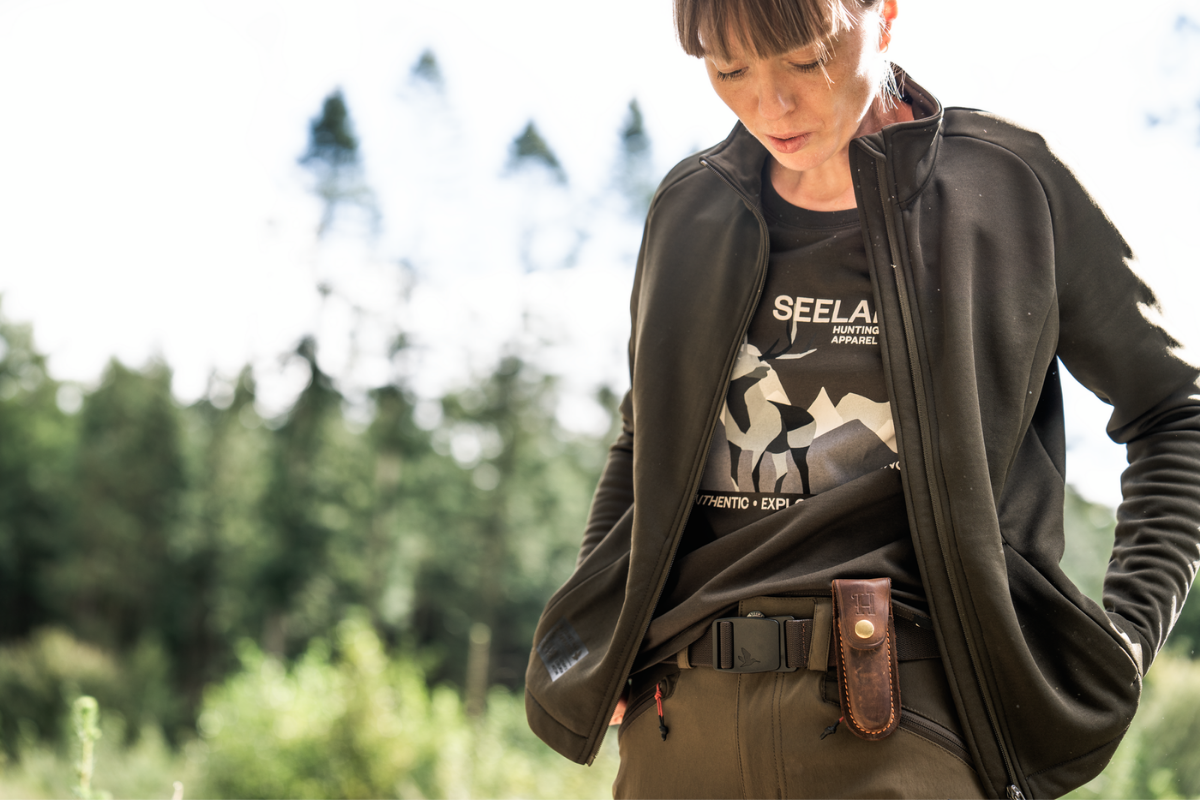
A fixed-blade knife should normally be carried securely in its sheath, while a folding knife can be kept safely in a pocket or suitable pouch. Some outdoor users also carry smaller fixed blades around the neck, particularly around camp where quick access can be convenient.
If your knife has a lanyard hole, a short length of brightly coloured paracord can make it easier to find if you drop it in grass or undergrowth. Reflective cord is particularly useful after dark. Be cautious with large loops, however, as they can catch on branches and potentially pull the knife from its sheath.
When passing a knife to another person, do it deliberately and safely. Never throw a knife, even when it is sheathed. Make sure the other person can take control of the handle without coming into contact with the cutting edge.
Using your knife with control
Most outdoor knife work involves some combination of pushing, slicing and chopping. A push cut is useful for controlled woodworking and carving, while a slicing action works well on materials such as rope and food. Chopping uses the weight and momentum of the knife and therefore requires considerably more awareness of where the blade will travel.
Your grip should always give you control over the edge. For powerful cuts, a conventional forehand grip with the blade pointing away from the body is generally the most natural. For finer work, moving your hand closer to the blade can improve precision, provided the knife is designed to be handled safely in this way.
Whatever technique you use, think about where the blade will go if it slips or passes unexpectedly through the material. Avoid working with a knife between or directly over your legs, and keep powerful cuts directed away from your body. The original Härkila guide places particular emphasis on avoiding the inner thigh because major blood vessels lie close beneath the skin.

One good knife or several?
For many hunters, one well-made knife with a plain edge will cover most situations. Keep it sharp, learn how it behaves and become comfortable using it safely, and it will handle a surprising range of jobs.
As your hunting develops, you may find that a second knife makes sense. A dedicated knife for handling game, for example, does not necessarily need to be the same knife you use for camp work or cutting wood.
The goal is not to own as many knives as possible. It is to have the right tool when you need it.
Choose a knife that suits the way you hunt, fits your hand comfortably and can be maintained without unnecessary difficulty. A knife you trust and know how to use will always be more valuable in the field than one chosen simply because it has the longest list of technical features.