Article: Hunting in Africa: A Female Hunter’s Story from South Africa and Namibia
Hunting in Africa: A Female Hunter’s Story from South Africa and Namibia
There is no such thing as an ordinary hunting day in Africa. One morning might begin with a stalk for zebra, another with searching for oryx or buffalo. And sometimes the day takes a completely unexpected turn.
I discovered this while working on game reserves in South Africa and Namibia. What began as an opportunity to experience hunting in Africa became something much bigger: months filled with challenging stalks, close encounters with wildlife, long days working in the bush and experiences that changed the way I see hunting.
 My First Hunting Adventure in South Africa
My relationship with Africa began in KwaZulu-Natal, South Africa, where I spent two and a half months working as an intern on a game reserve.
The landscape alone was enough to make an impression. Rocky mountains divided open grassland and savanna, while the Bushman’s River cut through the reserve below. Wildlife was everywhere. Driving down from the mountains, we could encounter white rhinos only metres away while a herd of hartebeest disappeared at full speed across the plains. Zebras moved through the wattle forest, their stripes surprisingly difficult to distinguish between the branches.
It did not take long before I had my first opportunity to hunt African game. My colleague Tyler, who later became one of my closest friends, and I had spent hours glassing from the top of a mountain in search of a suitable zebra. Eventually, a message crackled over the radio: a herd had been spotted on the opposite side of the valley.
We immediately started moving. To close the distance, we crawled through tall grass towards a stream that would give us enough cover to approach the herd. Puff adders were certainly something to think about, but at that moment our attention was firmly on the zebras.
Eventually, an old stallion separated slightly from the herd. At around 110 metres, he offered a clear opportunity. I released the safety, settled behind the rifle and slowly squeezed the trigger. The shot broke across the valley.
The stallion went down and the rest of the herd scattered into the savanna. He was both the largest animal I had ever taken and my first African game animal. At the time, I had no idea how much hunting would become part of everyday life on the reserve. Hunting there was not simply about individual experiences. The reserve had its own professional butchery, and game provided food for local communities and restaurants.
Nor was hunting our only responsibility. One day we might be out with the rifles; the next we could be checking fences with the rangers, repairing old Land Rovers or restoring damaged power cables. Mechanical repairs and electrical work were hardly my areas of expertise when I arrived, but Africa has a way of teaching you to solve whatever problem is in front of you.

Hunting Cape Buffalo at 20
In November 2021, an opportunity came along that I had never imagined I would get, particularly at the age of 20. I was going to hunt Cape buffalo.
George Cawood, my professional hunter, and Anthony Yard, owner of Tugela Safaris, had arranged a hunt for a buffalo cow on Anthony’s reserve in KwaZulu-Natal. Cape buffalo has a reputation as one of Africa’s most dangerous game animals, and this would be my first experience hunting one.
We spent time glassing from one hill to another until we located a large herd in the distance. George, Anthony, the local trackers and I loaded the vehicle and drove around the mountain to get into a better position. I knew we were going after buffalo.
What I did not yet understand was how close we were about to get.

Face to Face with a Herd of Buffalo
After leaving the vehicle, we began following the herd on foot. Slowly and deliberately, we tracked them through the wattle forest, constantly checking the wind and listening for movement ahead.
The uncertainty was perhaps the hardest part. Had the buffalo moved onto the open ground, or were dozens of them still concealed somewhere inside the thick vegetation?
We reached the edge of a clearing when George and Anthony suddenly stopped. I was behind them and was quietly waved forward. There they were. Around 130 metres away, approximately 70 buffalo were grazing calmly, apparently unaware of us. For a while, we simply watched through our binoculars. Then the wind changed.
Almost immediately, the atmosphere changed with it. Our scent reached a group of young bulls. They became alert and began moving towards us, trying to identify the danger. We stood completely still. No talking. No unnecessary movement.
I had the .375 on my back and found myself calculating what I would do if the buffalo decided to charge. George gave me a reassuring look, but there was no mistaking the seriousness of the situation. As the bulls came closer, I slowly moved backwards without even noticing it. “Emilie, if you move any further back, you’ll knock me over,” Anthony whispered. I had practically backed onto his feet. When I had agreed to hunt buffalo, this was not quite the scene I had pictured.
Then the opportunity appeared. A large cow moved clear of the herd and offered a clean shot. I took the rifle off safe, settled the crosshairs and fired. The bullet entered through the shoulder and reached the heart. The buffalo turned and began to run. Within roughly ten metres, I was able to place a second shot through the opposite shoulder, and she went down.
The tension disappeared almost instantly. George grinned. Anthony congratulated me. I started shaking. It was a mixture of adrenaline, relief and pride. I was 20 years old, far from Denmark and had just completed a Cape buffalo hunt in Africa. As a young woman working in an environment where most of the people around me were men, I had sometimes felt that I needed to demonstrate that I belonged there.
After that hunt, I no longer felt I had anything to prove.
Life on a South African Game Reserve
Hunting was only one part of my experience in South Africa. Working on the reserve also showed me a much more complicated side of wildlife management. Although our closest neighbours inside the fences were animals such as impala and warthog, there were communities beyond the reserve boundaries, and the relationship between conservation, wildlife and the people living nearby was not always simple.
Tyler led the reserve’s anti-poaching team. Together with the rangers and his Belgian Malinois, he responded whenever poachers entered the property. Many came from nearby communities, sometimes even with connections to people employed on the reserve. That created difficult situations.
For us, protecting the reserve meant protecting its wildlife. For someone struggling to find food or income, the same situation could look very different. We spent days and nights responding to incursions. Some poachers entered with packs of dogs and crude spears made from pieces of old fencing. Once inside, they could disappear astonishingly quickly. We might follow them into thick vegetation only to find that they had seemingly vanished – hiding in trees, dense bushes or even warthog burrows.
The experience showed me that poaching does not always have one simple motivation. In the area where I worked in South Africa, some people poached for food and out of desperation. Elsewhere, the reasons could be completely different. I would discover that when I travelled to Namibia.

A Different Side of Poaching in Namibia
The poaching I encountered in Namibia was very different from what I had experienced in South Africa. Here, trophy poaching was a serious concern, particularly for rhinos. Shortly before my arrival, two black rhinos had been killed for their horns. The methods used could be brutal, and protecting the reserve required constant vigilance.
One day, while guests were resting at the lodge, the anti-poaching alarm was raised. Two armed poachers had reportedly been seen running through the rhino area. Everything changed within minutes. Our professional hunters, Eddie and Christiaan, grabbed their rifles and vehicles. Police, anti-poaching teams and neighbouring farmers arrived to help search the reserve. A helicopter joined the operation from above while teams searched from the ground.
The search continued for hours. That night, Eddie and Christiaan remained in the field while Janina, the lodge manager, and I stayed in the office surrounded by radios, ready to relay information between the different teams. The two men were never found, but most importantly, no rhinos were harmed that night.
Hunting and Life in Namibia
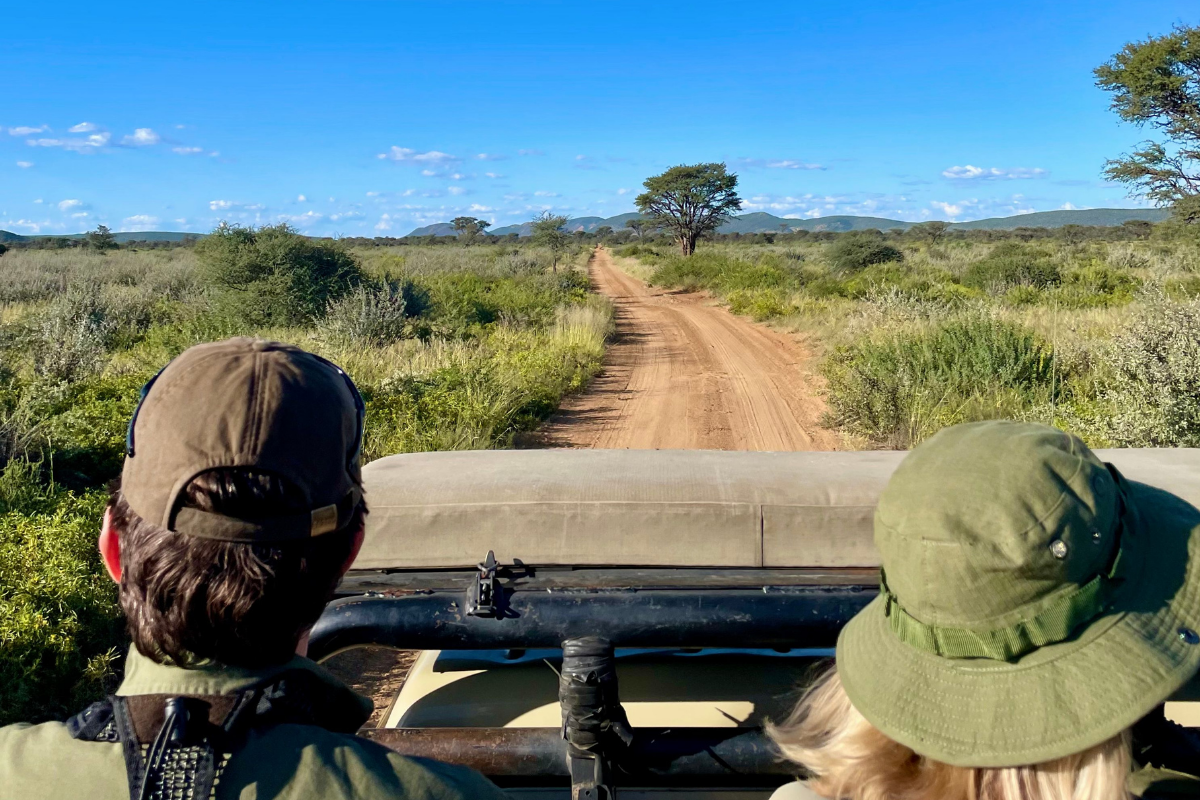
Namibia felt different from South Africa in almost every way. The work was different. The landscape was different. Even the colours seemed different. There is something about walking through thorn bush with fine red dust covering your boots while the evening sun turns the savanna shades of yellow, orange and deep red. On the dirt roads, gemsbok appeared between the bushes, springbok moved through the grass and giraffes stretched towards the highest leaves.
I had already travelled to many beautiful places with my family, but very little compares with sunrise or sunset in Namibia. And before leaving, there was one more animal I hoped to hunt. A mature gemsbok bull.
Stalking a Mature Gemsbok
My professional hunter and friend Eddie joined me for the hunt. We had already made several attempts when we finally located the bull we had been hoping to find. For days, Eddie and I had joked about crawling during a stalk. I loved it. Eddie was considerably less enthusiastic. This time, however, there was no alternative.
We dropped into the tall grass and began crawling until we reached a suitable shooting distance. As we tried to position the shooting sticks, the gemsbok noticed something. Every small movement caught his attention. Whenever he lowered his head to feed, we tried to adjust our position. Each time, he looked back towards us, stamping his feet and trying to determine whether we represented a threat.
Eddie suggested that I take the shot sitting down, but getting the shooting sticks into position without being detected proved almost impossible. Eventually, he slowly moved them aside and offered his shoulder as a rest for the rifle instead. Even in that tense moment, we looked at each other and had to smile at the strange shooting position we had managed to create. Then the bull turned and I fired. He ran approximately 100 metres before I was able to place another shot. The gemsbok went down.
After everything I had experienced, it felt like the perfect conclusion to my time in Namibia.
What Hunting in Africa Taught Me
Africa gave me far more than a collection of hunting memories. I arrived as a young Danish hunter eager to experience African wildlife and hunting firsthand. I left having worked alongside professional hunters, trackers and rangers; having learned about wildlife management and anti-poaching; and having experienced situations that pushed me well beyond what was familiar.
There were difficult moments and unforgettable ones. There were long stalks, mechanical problems, red dust, close encounters and evenings when the African sky seemed almost unreal. And there were the hunts themselves – from my first zebra in South Africa to Cape buffalo at 20 and, finally, the old gemsbok bull in Namibia.
Whether someone dreams of hunting African plains game, experiencing a safari or simply seeing the continent’s wildlife and landscapes firsthand, Africa has a way of staying with you. It certainly stayed with me.

About Emilie Nygaard
Emilie Nygaard is a Danish hunter with a deep passion for hunting and the outdoors. Her time working on game reserves in South Africa and Namibia gave her firsthand experience of African hunting, wildlife management and life in the bush. Back home in Scandinavia, she continues to spend as much time as possible hunting in the fields and forests.